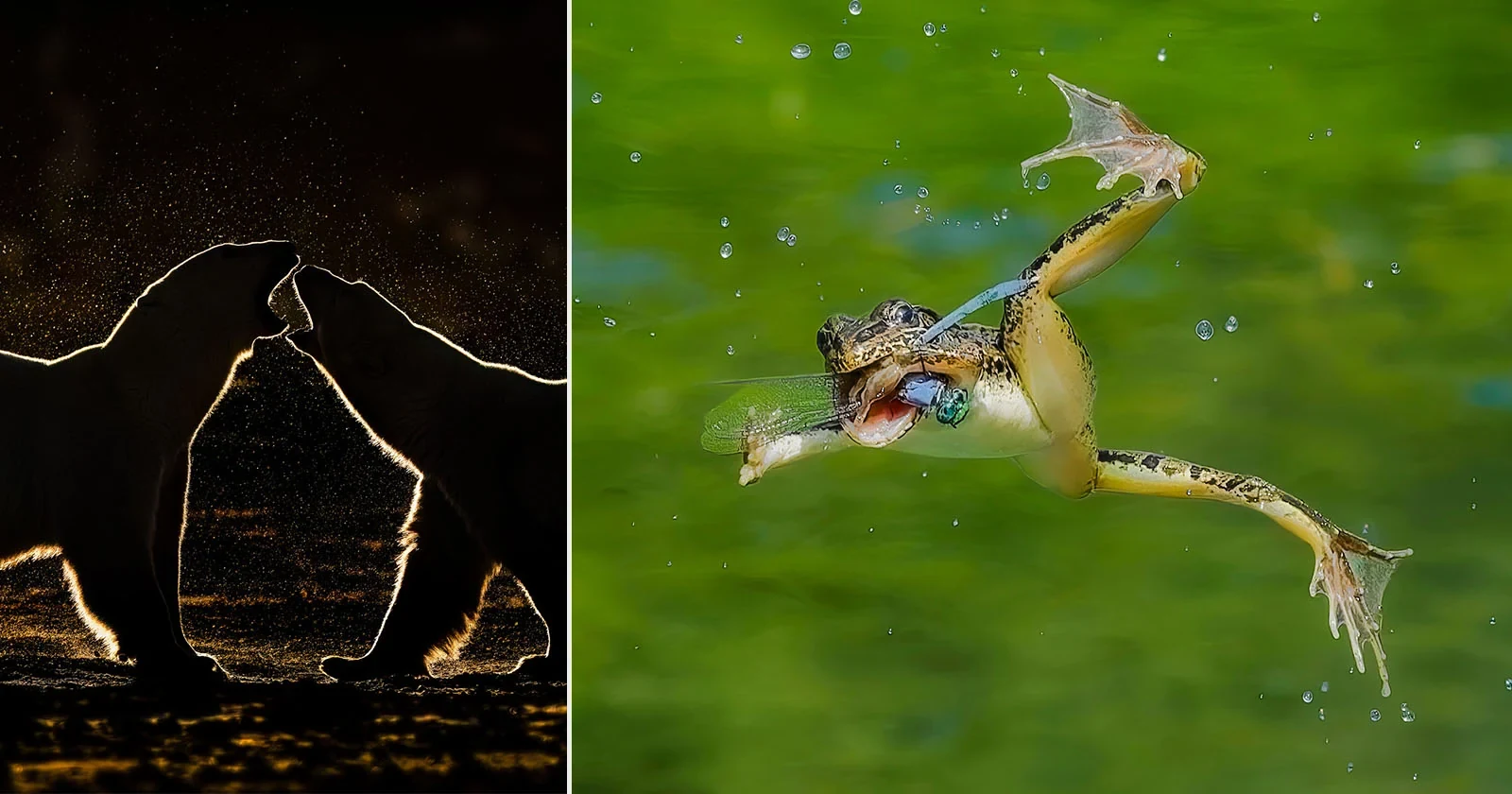
The North American Nature Photography Association (NANPA) has unveiled the incredible winning photos from its annual 2027 Showcase. The award-winning images show wildlife doing amazing things, stunning landscapes, and the most beautiful nature from around the world.
Best In Show
This year’s Best In Show winner is Texas-based nature and wildlife photographer Cissy Beasley, who won the top honor for her incredible shot of a frog catching a dragonfly in mid-air. It’s an exceptionally well-timed shot, with water droplets suspended in the air and the frog in a great pose.
“As we sat by a country pond, we watched a springy and ambitious Leopard Frog try his luck and skill at leaping up to snatch dragonflies from a perch or mid-air…over and over,” Beasley says. “Finally, he scored, securing an Eastern Pondhawk with his long, sticky tongue.”
Beasley’s photo also won the Macro / Micro / All Other category.
NANPA Showcase 2027 Category Winners
Alongside Beasley’s Best In Show victory, the NANPA Showcase 2027 recognized 249 othergreat nature photos, including winners across eight categories. The winners, runners-up, and Judges’ Choice honorees across all eight categories are featured below.
Charles Janson won the Birds category for his action-packed photo of a male Pileated Woodpecker hammering away at a dead Ponderosa Pine tree.
Mammals
Over in the Mammals category, this year’s winner is Kevin Lohman. Lohman’s award-winning photo shows a pair of polar bears in Churchill, Manitoba, Canada, clashing with beautiful backlight. It’s a stunning silhouette.
‘Scapes
In the ‘Scapes category, which is just a shortened version of landscapes, John Benford’s nighttime photo of Castle Geyser in Yellowstone National Park earned top marks.
Macro / Micro / All Other
The Best-In-Show winner Beasley also won the Macro / Micro / All Other category. Her winning photo is shown again here, alongside the first runner-up and two judges’ choice photos.
Conservation
The Conservation category is an emotional mixed bag this year. While some of the awarded photos offer reasons for hope, the winning photo by Graham Gerdeman shows a dead Great Horned Owl lying face down in a puddle at a city cemetery in Nashville, Tennessee. It was the second Great Horned Owl found dead like this. No necropsy was performed despite the cemetery’s proximity to industrial sites.
Altered Reality
Creative approaches to photography are encouraged in the Altered Reality category. The winning image by Dave Hattori has been heavily edited in Photoshop to create artistic special effects, while the first runner-up is a composite of 139 photos showing the consistent flight patterns of Gannets in Norway.
Comedy / HumorWhile not strictly focused on comedic wildlife photos like the Nikon Comedy Wildlife Awards, the NANPA Showcase still offers plenty of laughs. This year’s winning photo by Kevin Lohman shows a seven-week-old Great Horned Owl fledgling looking shocked as a gray squirrel jumped at it. Lohman adds that although the owl did fall off its perch, it was thankfully unharmed.‹›1/4“Are You Kidding Me?,” Santa Cruz, California. © Kevin Lohman | Comedy / Humor, Best in Category | NANPA Showcase 2027.“Stealthy Moose,” Grand Teton National Park, Wyoming. © Peter Batty | Comedy / Humor, First Runner-Up | NANPA Showcase 2027.“New Hat,” Upper Yahara River Trail, DeForest, Wisconsin. © Thomas McDonald | Comedy / Humor, Judges’ Choice | NANPA Showcase 2027.“Preferred Parking,” Natural Bridges State Beach, Santa Cruz, California. © Kevin Lohman | Comedy / Humor, Judges’ Choice | NANPA Showcase 2027. Series While all the other categories focus on single image entries, the Series category asks photographers to submit seven photos related to a specific topic. In this case, photographer Parham Pourahmad’s winning series tells the story of how coyotes have adapted to more urban lifestyles and habitats in the San Francisco Bay Area. Pourahmad’s seven photos plus the seven shots from the three other winners are featured below.‹›1/28“The Urban Coyote,” image 1 of 7, San Francisco, California and Palo Alto, California. © Parham Pourahmad | Series, Best in Category | NANPA Showcase 2027.“The Urban Coyote,” image 2 of 7, San Francisco, California and Palo Alto, California. © Parham Pourahmad | Series, Best in Category | NANPA Showcase 2027.“The Urban Coyote,” image 3 of 7, San Francisco, California and Palo Alto, California. © Parham Pourahmad | Series, Best in Category | NANPA Showcase 2027.“The Urban Coyote,” image 4 of 7, San Francisco, California and Palo Alto, California. © Parham Pourahmad | Series, Best in Category | NANPA Showcase 2027.“The Urban Coyote,” image 5 of 7, San Francisco, California and Palo Alto, California. © Parham Pourahmad | Series, Best in Category | NANPA Showcase 2027.“The Urban Coyote,” image 6 of 7, San Francisco, California and Palo Alto, California. © Parham Pourahmad | Series, Best in Category | NANPA Showcase 2027.“The Urban Coyote,” image 7 of 7, San Francisco, California and Palo Alto, California. © Parham Pourahmad | Series, Best in Category | NANPA Showcase 2027.“A Yellowstone Winter Story: Predator, Then Prey,” image 1 of 7, Yellowstone National Park, Wyoming. © Jerry Jividen | Series, First Runner-Up | NANPA Showcase 2027.“A Yellowstone Winter Story: Predator, Then Prey,” image 2 of 7, Yellowstone National Park, Wyoming. © Jerry Jividen | Series, First Runner-Up | NANPA Showcase 2027.“A Yellowstone Winter Story: Predator, Then Prey,” image 3 of 7, Yellowstone National Park, Wyoming. © Jerry Jividen | Series, First Runner-Up | NANPA Showcase 2027.“A Yellowstone Winter Story: Predator, Then Prey,” image 4 of 7, Yellowstone National Park, Wyoming. © Jerry Jividen | Series, First Runner-Up | NANPA Showcase 2027.“A Yellowstone Winter Story: Predator, Then Prey,” image 5 of 7, Yellowstone National Park, Wyoming. © Jerry Jividen | Series, First Runner-Up | NANPA Showcase 2027.“A Yellowstone Winter Story: Predator, Then Prey,” image 6 of 7, Yellowstone National Park, Wyoming. © Jerry Jividen | Series, First Runner-Up | NANPA Showcase 2027.“A Yellowstone Winter Story: Predator, Then Prey,” image 7 of 7, Yellowstone National Park, Wyoming. © Jerry Jividen | Series, First Runner-Up | NANPA Showcase 2027.
During two weeks in Yellowstone National Park in winter, I photographed a remarkable sequence of encounters that revealed how quickly the roles of predator and prey can change. Across several days, three species, a vole, an ermine, and a coyote, became connected through a story of hunting, survival, and predation.
The saga began with an ermine hunting in Yellowstone’s interior. I watched and photographed as it moved rapidly over the snow and ice, pausing and searching for prey hidden beneath the snowpack. Suddenly, the ermine disappeared beneath the snow. Moments later, it emerged carrying a vole in its mouth and quickly moved away with its catch.“From Above: Flamingos over Lake Magadi and Lake Natron,” image 1 of 7, Lake Magadi and Lake Natron, Kenya. © Holly Kirkland | Series, Judges’ Choice | NANPA Showcase 2027.“From Above: Flamingos over Lake Magadi and Lake Natron,” image 2 of 7, Lake Magadi and Lake Natron, Kenya. © Holly Kirkland | Series, Judges’ Choice | NANPA Showcase 2027.“From Above: Flamingos over Lake Magadi and Lake Natron,” image 3 of 7, Lake Magadi and Lake Natron, Kenya. © Holly Kirkland | Series, Judges’ Choice | NANPA Showcase 2027.“From Above: Flamingos over Lake Magadi and Lake Natron,” image 4 of 7, Lake Magadi and Lake Natron, Kenya. © Holly Kirkland | Series, Judges’ Choice | NANPA Showcase 2027.“From Above: Flamingos over Lake Magadi and Lake Natron,” image 5 of 7, Lake Magadi and Lake Natron, Kenya. © Holly Kirkland | Series, Judges’ Choice | NANPA Showcase 2027.“From Above: Flamingos over Lake Magadi and Lake Natron,” image 6 of 7, Lake Magadi and Lake Natron, Kenya. © Holly Kirkland | Series, Judges’ Choice | NANPA Showcase 2027.“From Above: Flamingos over Lake Magadi and Lake Natron,” image 7 of 7, Lake Magadi and Lake Natron, Kenya. © Holly Kirkland | Series, Judges’ Choice | NANPA Showcase 2027. From above, the lakes of Magadi and Natron reveal an extraordinary exchange between geology and life. Minerals, algae, water, and sediment create shifting fields of blue, pink, rust, and gold. These same alkaline waters support the microscopic life that draws vast numbers of flamingos here to feed. The colors and the birds are not separate phenomena, but expressions of the same ecosystem. The flamingos, in turn, leave their own marks upon it. As they wade and feed, they draw delicate lines through the sediment; gathered by the thousands, their bodies become patterns of their own; in flight, they cross above the traces left behind below. Across the series, scale shifts between individual bird, flock, pattern, and the larger forms of the lakes themselves. Seen from the air, the landscape is not simply a backdrop for the flamingos. It is the reason they are here—and through their movement, they become part of its design.“A Peregrine Falcon Breeding Season, Start to Finish,” image 1 of 7, Central Coast of California, San Mateo and Sonoma Counties. © Corey Raffel | Series, Judges’ Choice | NANPA Showcase 2027. The Peregrine Falcon population has largely recovered from the devastation caused by the use of the insecticide DDT in the 1960s. Many pairs of these raptors now nest in caves in cliffs along the California coast. While these falcons are said to mate for life, I think that calling them "breeding site loyal" is a better description. Pairs spend the time outside the breeding season separately but come together again at the breeding site at the start of the season in late winter. After the offspring have successfully fledged, the male and female again go off on their separate ways. During the breeding season, pairs of peregrines use an interwoven, yet flexible, set of behaviors that hopefully result in the successful production of independent offspring. Population growth continues as a result of these interactions between the parents with each other and with their offspring. I have spent hours of time watching and photographing three pairs of these raptors during the breeding season for the past seven years. All of these nest sites are in caves along the central coast of California from San Mateo County north to Sonoma County. This series shows activities of the breeding birds and their offspring from the beginning to the end of the breeding season. The population growth of this once endangered species due to the banning of DDT and extensive conservation efforts also depends on the birds' successful use of the behaviors illustrated here.“A Peregrine Falcon Breeding Season, Start to Finish,” image 2 of 7, Central Coast of California, San Mateo and Sonoma Counties. © Corey Raffel | Series, Judges’ Choice | NANPA Showcase 2027. The Peregrine Falcon population has largely recovered from the devastation caused by the use of the insecticide DDT in the 1960s. Many pairs of these raptors now nest in caves in cliffs along the California coast. While these falcons are said to mate for life, I think that calling them "breeding site loyal" is a better description. Pairs spend the time outside the breeding season separately but come together again at the breeding site at the start of the season in late winter. After the offspring have successfully fledged, the male and female again go off on their separate ways. During the breeding season, pairs of peregrines use an interwoven, yet flexible, set of behaviors that hopefully result in the successful production of independent offspring. Population growth continues as a result of these interactions between the parents with each other and with their offspring. I have spent hours of time watching and photographing three pairs of these raptors during the breeding season for the past seven years. All of these nest sites are in caves along the central coast of California from San Mateo County north to Sonoma County. This series shows activities of the breeding birds and their offspring from the beginning to the end of the breeding season. The population growth of this once endangered species due to the banning of DDT and extensive conservation efforts also depends on the birds' successful use of the behaviors illustrated here.“A Peregrine Falcon Breeding Season, Start to Finish,” image 3 of 7, Central Coast of California, San Mateo and Sonoma Counties. © Corey Raffel | Series, Judges’ Choice | NANPA Showcase 2027. The Peregrine Falcon population has largely recovered from the devastation caused by the use of the insecticide DDT in the 1960s. Many pairs of these raptors now nest in caves in cliffs along the California coast. While these falcons are said to mate for life, I think that calling them "breeding site loyal" is a better description. Pairs spend the time outside the breeding season separately but come together again at the breeding site at the start of the season in late winter. After the offspring have successfully fledged, the male and female again go off on their separate ways. During the breeding season, pairs of peregrines use an interwoven, yet flexible, set of behaviors that hopefully result in the successful production of independent offspring. Population growth continues as a result of these interactions between the parents with each other and with their offspring. I have spent hours of time watching and photographing three pairs of these raptors during the breeding season for the past seven years. All of these nest sites are in caves along the central coast of California from San Mateo County north to Sonoma County. This series shows activities of the breeding birds and their offspring from the beginning to the end of the breeding season. The population growth of this once endangered species due to the banning of DDT and extensive conservation efforts also depends on the birds' successful use of the behaviors illustrated here.“A Peregrine Falcon Breeding Season, Start to Finish,” image 4 of 7, Central Coast of California, San Mateo and Sonoma Counties. © Corey Raffel | Series, Judges’ Choice | NANPA Showcase 2027. The Peregrine Falcon population has largely recovered from the devastation caused by the use of the insecticide DDT in the 1960s. Many pairs of these raptors now nest in caves in cliffs along the California coast. While these falcons are said to mate for life, I think that calling them "breeding site loyal" is a better description. Pairs spend the time outside the breeding season separately but come together again at the breeding site at the start of the season in late winter. After the offspring have successfully fledged, the male and female again go off on their separate ways. During the breeding season, pairs of peregrines use an interwoven, yet flexible, set of behaviors that hopefully result in the successful production of independent offspring. Population growth continues as a result of these interactions between the parents with each other and with their offspring. I have spent hours of time watching and photographing three pairs of these raptors during the breeding season for the past seven years. All of these nest sites are in caves along the central coast of California from San Mateo County north to Sonoma County. This series shows activities of the breeding birds and their offspring from the beginning to the end of the breeding season. The population growth of this once endangered species due to the banning of DDT and extensive conservation efforts also depends on the birds' successful use of the behaviors illustrated here.“A Peregrine Falcon Breeding Season, Start to Finish,” image 5 of 7, Central Coast of California, San Mateo and Sonoma Counties. © Corey Raffel | Series, Judges’ Choice | NANPA Showcase 2027. The Peregrine Falcon population has largely recovered from the devastation caused by the use of the insecticide DDT in the 1960s. Many pairs of these raptors now nest in caves in cliffs along the California coast. While these falcons are said to mate for life, I think that calling them "breeding site loyal" is a better description. Pairs spend the time outside the breeding season separately but come together again at the breeding site at the start of the season in late winter. After the offspring have successfully fledged, the male and female again go off on their separate ways. During the breeding season, pairs of peregrines use an interwoven, yet flexible, set of behaviors that hopefully result in the successful production of independent offspring. Population growth continues as a result of these interactions between the parents with each other and with their offspring. I have spent hours of time watching and photographing three pairs of these raptors during the breeding season for the past seven years. All of these nest sites are in caves along the central coast of California from San Mateo County north to Sonoma County. This series shows activities of the breeding birds and their offspring from the beginning to the end of the breeding season. The population growth of this once endangered species due to the banning of DDT and extensive conservation efforts also depends on the birds' successful use of the behaviors illustrated here.“A Peregrine Falcon Breeding Season, Start to Finish,” image 6 of 7, Central Coast of California, San Mateo and Sonoma Counties. © Corey Raffel | Series, Judges’ Choice | NANPA Showcase 2027.
The Peregrine Falcon population has largely recovered from the devastation caused by the use of the insecticide DDT in the 1960s. Many pairs of these raptors now nest in caves in cliffs along the California coast. While these falcons are said to mate for life, I think that calling them "breeding site loyal" is a better description. Pairs spend the time outside the breeding season separately but come together again at the breeding site at the start of the season in late winter. After the offspring have successfully fledged, the male and female again go off on their separate ways. During the breeding season, pairs of peregrines use an interwoven, yet flexible, set of behaviors that hopefully result in the successful production of independent offspring. Population growth continues as a result of these interactions between the parents with each other and with their offspring. I have spent hours of time watching and photographing three pairs of these raptors during the breeding season for the past seven years. All of these nest sites are in caves along the central coast of California from San Mateo County north to Sonoma County. This series shows activities of the breeding birds and their offspring from the beginning to the end of the breeding season. The population growth of this once endangered species due to the banning of DDT and extensive conservation efforts also depends on the birds' successful use of the behaviors illustrated here.“A Peregrine Falcon Breeding Season, Start to Finish,” image 7 of 7, Central Coast of California, San Mateo and Sonoma Counties. © Corey Raffel | Series, Judges’ Choice | NANPA Showcase 2027. The Peregrine Falcon population has largely recovered from the devastation caused by the use of the insecticide DDT in the 1960s. Many pairs of these raptors now nest in caves in cliffs along the California coast. While these falcons are said to mate for life, I think that calling them "breeding site loyal" is a better description. Pairs spend the time outside the breeding season separately but come together again at the breeding site at the start of the season in late winter. After the offspring have successfully fledged, the male and female again go off on their separate ways. During the breeding season, pairs of peregrines use an interwoven, yet flexible, set of behaviors that hopefully result in the successful production of independent offspring. Population growth continues as a result of these interactions between the parents with each other and with their offspring. I have spent hours of time watching and photographing three pairs of these raptors during the breeding season for the past seven years. All of these nest sites are in caves along the central coast of California from San Mateo County north to Sonoma County. This series shows activities of the breeding birds and their offspring from the beginning to the end of the breeding season. The population growth of this once endangered species due to the banning of DDT and extensive conservation efforts also depends on the birds' successful use of the behaviors illustrated here. More From NANPA Showcase 2027Alongside the winning photos featured above, the 2027 NANPA Showcase judges recognized 250 works, including in the Top 100andTop 250galleries. All of these recognized photos are available to view onNANPA’s website. Image creditsNorth American Nature Photography Association (NANPA) Showcase 2027. All photographers are credited in the image captions.